
In today's pharmaceutical landscape, launching a promising therapy is only the beginning. The real challenge lies in ensuring that innovation translates into access, adoption, and long-term value for patients, payers, and healthcare systems. At Stellar Consulting, we help life sciences companies navigate this journey by combining market access strategy, health technology assessment, and health economics expertise to build stronger value stories and faster routes to reimbursement.
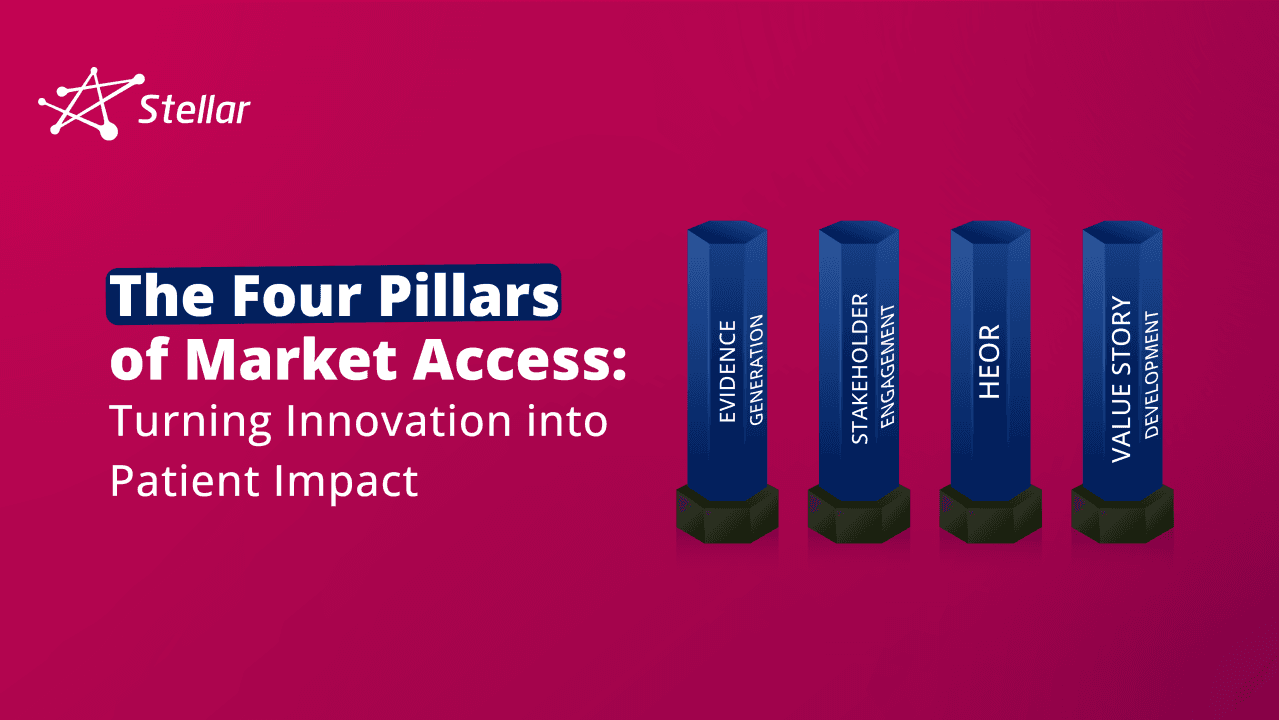
Market access has become one of the most critical success factors in pharma. Regulatory approval may open the door, but it does not guarantee that a therapy will be funded, adopted, or used at scale. That is why companies need a strategy built around four essential pillars: evidence generation, pricing and reimbursement, stakeholder engagement, and health economics and outcomes research (HEOR). When these pillars work together, they create a compelling case for value that supports both commercial success and patient benefit.
1. Evidence Generation: The Foundation of Value
The first pillar of market access is evidence generation, and it remains the foundation of every successful access strategy. Regulators may focus on safety and efficacy, but payers and decision-makers often need a broader story: how does the therapy compare with current standards of care, what is the patient value, and what impact will it have on healthcare resource use?
That means evidence planning should start early, long before launch. Study design, endpoint selection, comparator choice, and real-world evidence planning should all be aligned with payer expectations from the outset. When evidence is developed with access in mind, companies are better positioned to answer the questions that matter most and avoid costly gaps later in the process.
2. Stakeholder Engagement
Market access is not just a data exercise. It is also a relationship-driven process that depends on trust, dialogue, and alignment across the healthcare ecosystem. Early engagement with payers, clinicians, patient groups, and regulators can uncover barriers, clarify expectations, and improve the chances of a smoother launch.
This is especially important in therapy areas where treatment decisions are complex and access pathways are highly scrutinized. Patient input, in particular, is becoming increasingly influential, especially when quality of life and treatment burden are part of the value discussion. Through stakeholder mapping, advisory support, and structured engagement planning, Stellar Consulting helps clients strengthen their access story and build confidence among decision-makers.
3. HEOR
Health economics and outcomes research gives the access story its quantitative power. It translates clinical benefit into economic value through tools such as cost-effectiveness analysis, budget impact modeling, and HTA-ready dossiers. For payers, this evidence is often essential for deciding whether a product delivers enough value to justify reimbursement.
HEOR is especially important in markets where local decision-making criteria differ and where one global model is not enough. Analyses often need to be adapted to local disease burden, resource use patterns, and willingness to pay expectations. At Stellar Consulting, we develop tailored HEOR and HTA support that helps clients make a stronger case for value in diverse regional markets, including MENA and GCC.
4. Value Story Development & Communication
This pillar brings all elements together through a clear, consistent value story that resonates with payers, clinicians, and patients. This involves crafting compelling narratives, messaging frameworks, and communication plans that translate complex evidence into accessible insights.
Value communication goes beyond data presentation — it addresses payer priorities like unmet need, comparative advantage, budget impact, and patient-centered outcomes. Tools include payer dossiers, slide decks, infographics, and digital platforms tailored to local contexts.
In value-based markets, this pillar differentiates leaders from laggards. Stellar Consulting develops payer ready value stories, including PICOS frameworks and executive summaries, that have accelerated HTA submissions and negotiations in GCC markets.
Conclusion
Market access is now a central driver of pharmaceutical success, and the companies that treat it as a strategic priority are better positioned to win in increasingly value-based healthcare systems. The four pillars, evidence generation, pricing and reimbursement, stakeholder engagement, and HEOR, create the structure needed to connect innovation with access.
At Stellar Consulting, we help pharmaceutical and biotech companies build that connection through tailored market access, HTA, and health economics solutions that are designed for today's evolving payer environment. In a world where proof of value matters more than ever, early market access planning is not just helpful; it is essential.
References:
-
Garrison LP et al. Assessing the Value of Integrated Evidence Approaches in Drug Development. Value Health Open. 2025.
-
McAuslane N et al. The need to consider market access for pharmaceutical investment decisions. J Comp Eff Res. 2025.
-
Lifescience Dynamics. "What Are the Pillars of Market Access?" lifesciencedynamics.com.
-
Taylor D et al. The value of evidence and its role in driving product strategy. J Mark Access Health Policy. 2024.